You need an event tent for 20 people.
That sounds like a reasonably precise brief.
But what will those 20 people actually be doing?
Standing around a bar? Sitting through a presentation? Walking around a displayed vehicle? Waiting to sample a product? Or are those 20 visitors only part of the equation, with a promotional counter, screen, storage area and four members of staff also inside?
The number of people alone is not enough to determine the right event tent size.
At minimum, you need to consider:
- number of people,
- how the space will be used,
- equipment inside the structure.
Together, these factors provide a much more realistic picture of the space required.
Why Can’t Event Tent Size Be Determined by Guest Numbers Alone?
Imagine two events with 30 visitors.
At the first, guests approach a promotional counter, collect a sample and leave after a few minutes.
At the second, all 30 visitors need to sit through a product presentation.
Same number of people.
Completely different spatial requirements.
A more useful question is therefore:
How many people will be inside at the same time, and what will they be doing?
1. Determine How Many People Will Be Inside at the Same Time
Total event attendance is not the same as required tent capacity.
A festival may attract 10,000 visitors while only a few dozen people occupy your brand activation at any one time.
A corporate presentation for 50 guests, on the other hand, may need space for all 50 simultaneously.
Distinguish between:
- total event attendance,
- expected traffic through your activation,
- maximum simultaneous occupancy.
The final figure is generally the most relevant when planning space.
2. Consider What Visitors Will Be Doing
Different activities require different amounts of space.
Promotion and Sampling
Visitors move through the activation relatively quickly. Easy access to the promotional counter and clear entrances may matter more than seating capacity.
Product Presentation
Large products, machinery, technology or vehicles can occupy a significant portion of the floor area.
Visitors also need room to move around the exhibit.
Seating and Presentations
Chairs, tables, presentation equipment and aisles increase the space required.
Hospitality or VIP Areas
Seating, catering, high tables and service areas create a completely different layout from an open promotional point.
That is why “a tent for 30 people” always needs a second sentence:
What will those 30 people be doing?
3. Include the People Working at the Event
Visitors are not the only occupants.
The space may also contain:
- promoters and hosts,
- sales staff,
- technicians,
- catering staff,
- presenters,
- product specialists.
If you expect 20 visitors while five members of staff are working inside, the structure is actually accommodating 25 people plus equipment.
4. Calculate Equipment, Not Just People
An empty floor plan can look surprisingly generous.
Then you add:
- a promotional counter,
- screens,
- products,
- shelving,
- tables,
- chairs,
- a bar,
- technical equipment,
- storage.
The free space quickly disappears.
Before selecting a size, make a simple list of everything that needs to fit under the roof.
How Many People Can Fit Inside an Inflatable Event Tent?
There is no universal occupancy figure based solely on tent dimensions.
Capacity depends on the specific model, layout, intended activity, equipment and applicable event safety requirements.
It would therefore be misleading to claim that a particular tent size automatically accommodates a fixed number of people without knowing the configuration.
A better assessment considers:
- simultaneous occupancy,
- type of activity,
- equipment,
- required circulation space,
- the specific structure.
How to Choose Inflatable Tent Size by Event Type
Roadshows: Balance Space and Mobility
A roadshow tent is not being selected for one location.
It will repeatedly travel, be installed and packed away.
Balance:
- presentation space,
- available footprints at different venues,
- transport,
- handling,
- repeated installation.
The largest possible structure is therefore not automatically the most practical one.
Festivals: Plan for Visitor Flow
Visitors often enter and leave festival brand activations continuously.
Important considerations may include:
- openness,
- easy entry and exit,
- brand visibility,
- activation space,
- room for staff.
With high footfall, visitor flow can matter more than theoretical maximum occupancy.
Trade Shows: Give Every Metre a Purpose
Exhibition plots often have fixed dimensions.
Space may be required for:
- products,
- promotional counters,
- screens,
- meeting areas,
- visitors,
- staff.
The structure should therefore be planned around the actual exhibition footprint.
Motorsport: Include Equipment
In a paddock or service park, visitors may not be the main users of the space.
Floor area can be occupied by:
- technical equipment,
- team gear,
- spare parts,
- work areas,
- a vehicle or motorcycle.
Dimensions should therefore follow the team’s workflow rather than headcount alone.
Corporate Events: Let the Programme Define the Space
Networking means people move around.
Presentations mean people sit.
Product launches may dedicate a significant part of the space to the product and AV equipment.
Size should follow the programme, not merely the guest list.
A 5-Step Framework for Choosing the Right Size
Step 1: Determine Maximum Simultaneous Occupancy
Not total attendance. The realistic peak inside your activation.
Step 2: Define the Main Activity
Standing, sampling, seating, presenting, selling, hospitality or technical support?
Step 3: List All Equipment
From promotional counters to the product itself.
Step 4: Allow for Movement
Visitors need to enter, leave and move between individual elements.
Step 5: Select the Specific Structure
Now you can compare models against an actual requirement rather than a guessed dimension.
Example: AXION SQUARE Sizes
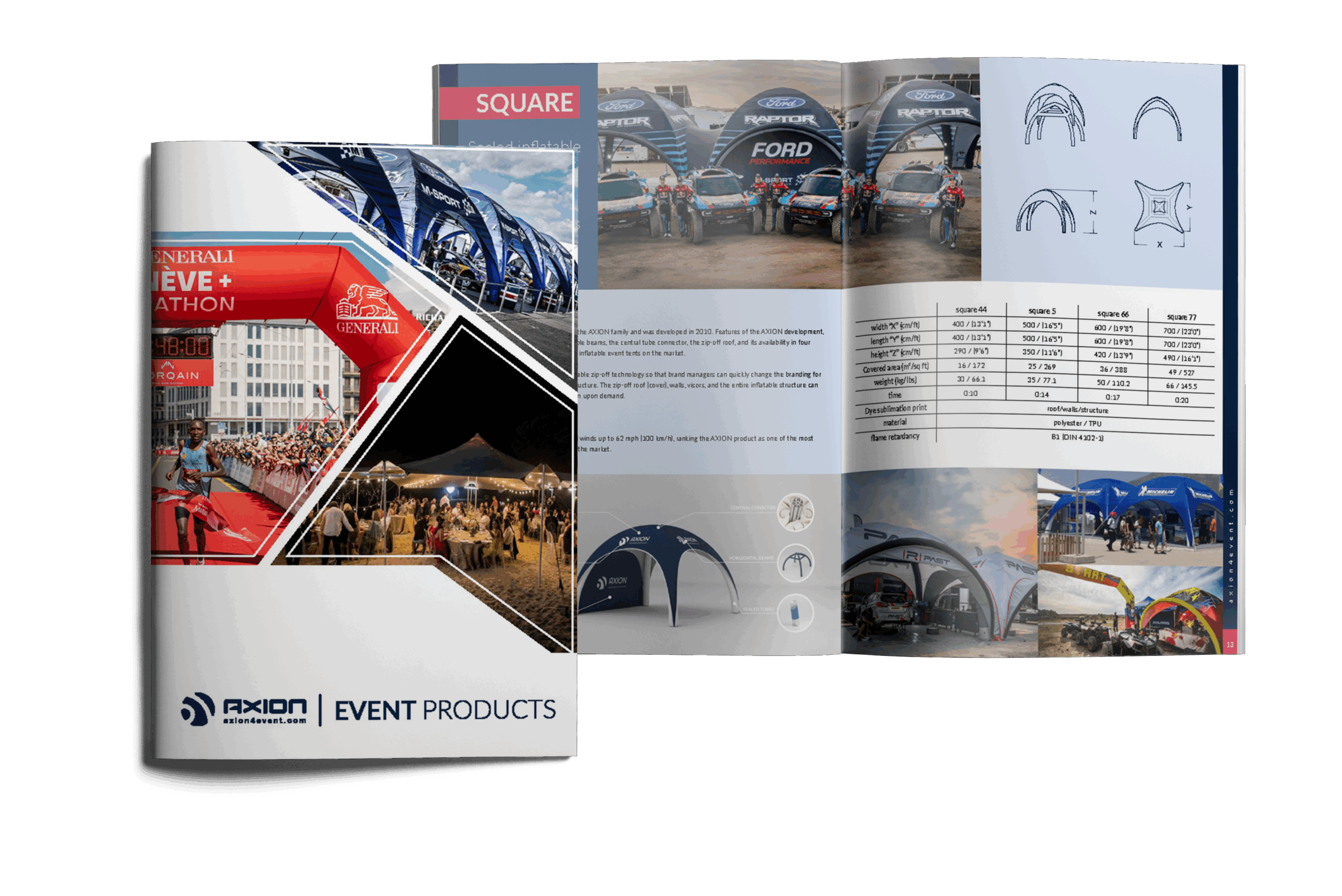
To make the framework above more concrete, here are the four sizes of the AXION SQUARE sealed inflatable tent:
| Model | Footprint | Covered area | Height | Set-up time |
|---|---|---|---|---|
| SQUARE 44 | 4 × 4 m (13’1″ × 13’1″) | 16 m² (172 sq ft) | 2.9 m (9’6″) | 10 min |
| SQUARE 55 | 5 × 5 m (16’5″ × 16’5″) | 25 m² (269 sq ft) | 3.5 m (11’6″) | 14 min |
| SQUARE 66 | 6 × 6 m (19’8″ × 19’8″) | 36 m² (388 sq ft) | 4.2 m (13’9″) | 17 min |
| SQUARE 77 | 7 × 7 m (23’0″ × 23’0″) | 49 m² (527 sq ft) | 4.9 m (16’1″) | 20 min |
The covered area tells you how much floor you have to work with. How many people fit comfortably still depends on the activity and equipment described above.
If a square footprint does not suit your event, AXION also offers other shapes, including the CUBE, HEXA, SPIDER and POD.
Should You Simply Choose a Larger Tent “Just in Case”?
Not automatically.
Extra space can be useful, but an oversized structure can also:
- require a larger event footprint,
- complicate logistics,
- feel underused at smaller events,
- fail to fit some planned venues.
The goal is not to choose the largest tent available, but a size that matches how the structure will actually be used.
How Do Side Walls Affect Usable Space?
An open and a more enclosed configuration of the same structure can feel very different.
Side walls can provide:
- greater privacy,
- separate presentation areas,
- additional protection for exhibits,
- more prominent branding surfaces.
They can also affect entrances, visitor flow and the overall perception of the space.
Wall configuration should therefore be considered when planning the layout.
Can One Tent Work Across Different Event Types?
If you are investing in your own event infrastructure, you probably do not intend to use it only once.
Consider your most common use case, rather than designing exclusively around the largest event in the calendar.
If you attend ten smaller roadshows and one large festival, choosing the entire solution solely around that festival may not be practical.
Depending on the selected product, modularity or different configurations may provide a better approach.
Selected AXION models also use multiple independent air chambers and stabilising elements. Exact configuration options should, however, be assessed for the individual product.
What Should You Tell the Supplier If You Don’t Know the Size?
You do not need to say:
“We need exactly 6 × 6 metres (about 20 × 20 ft).”
It may be far more useful to say:
“We need a branded tent for a roadshow. Two members of staff, a promotional counter and a displayed product will be inside. We expect approximately 10 to 15 visitors at a time, and the structure will travel frequently throughout the season.”
That allows size to be considered in the context of actual use.
Common Mistakes When Choosing Event Tent Size
1. Counting Visitors but Forgetting Staff
Staff and equipment have a curious habit of reappearing once the event opens. 🙂
2. Using Total Event Attendance
A festival with 10,000 visitors does not require a tent for 10,000 people.
3. Forgetting Circulation Space
A space that can theoretically be filled is not necessarily a space that functions well.
4. Choosing the Largest Model for Extra Capacity
Extra capacity only helps until it begins complicating transport and venue compatibility.
5. Planning Around One Event Only
If you own the structure, consider the entire event calendar.
Frequently Asked Questions
How do I choose the right size inflatable tent for an event?
Consider maximum simultaneous occupancy, activity type, staff, equipment and required circulation space. Then select a specific size and model based on those requirements.
How many people can fit inside an inflatable event tent?
There is no universal capacity based on dimensions alone. Occupancy depends on the specific model, layout, equipment, intended use and applicable event requirements.
Should I use total event attendance to determine tent size?
No. Maximum simultaneous occupancy within your own event space is usually much more relevant.
What size inflatable tent do I need for a roadshow?
It depends on the number of people, equipment and available footprint at each location. Transport and repeated handling should also be considered.
Is it better to choose a larger tent for extra capacity?
Not always. An oversized structure can complicate transport and may not fit all venues.
Do side walls affect the space?
Yes. Wall configuration can affect visitor movement, entrances and how the interior is used.
Do I need to know the exact dimensions before requesting a quote?
No. Describe the number of people, activity, equipment and available footprint. This can provide a better basis for selecting a solution than a guessed size.
Can the same inflatable tent be used for different event types?
Yes, provided its dimensions, configuration and intended use suit those events. When investing in your own structure, consider the entire event calendar.
Pre-Selection Checklist
- ✓ Maximum simultaneous visitor count
- ✓ Number of staff
- ✓ Main activity
- ✓ Products and technical equipment
- ✓ Counters, tables and seating
- ✓ Entrances and circulation routes
- ✓ Indoor/outdoor use
- ✓ Available event footprint
- ✓ Transport requirements
- ✓ Side-wall configuration
- ✓ Frequency of use
Conclusion
The right event tent size cannot be calculated by dividing your guest count by one magical number.
What matters is what needs to happen inside the space.
Twenty visitors sampling a product, twenty people attending a seated presentation and twenty guests walking around a large exhibit represent three completely different spatial briefs.
Instead of starting with:
“How many people fit inside this tent?”
start with:
“What needs to happen comfortably and efficiently inside this space?”
Then choose the dimensions.
Find the Right Structure for Your Event
Tell AXION about your event type, expected visitor numbers, activity and equipment. Based on the actual requirements, you can identify a suitable inflatable structure and visualise it with your branding.
Customers in the United States can contact ZEPELIN USA directly at sales@axion4event.com or +1 (239) 428 1027.