How many events can one inflatable tent handle?
Ten? Fifty? A hundred?
For a professional event structure, lifespan cannot be reduced to a single number.
It depends on a combination of materials, construction, frequency of use, installation, weather exposure, transportation, maintenance and storage.
Two companies can own the same model and see it age at very different rates.
The lifespan of an inflatable event tent is therefore determined not simply by its age, but by how often, where and how it is used and cared for between events.
How Many Years Does an Inflatable Event Tent Last?
This varies widely, as it is closely tied to the care you give the tent before, during, and after each event.
It also depends on how it is stored: humidity, cold, heat and overall storage conditions play a huge role.
Proper maintenance of the valves and their rubber seals is essential, too.
Finally, careful handling during setup and teardown is critical: assessing the setup location, checking the ground before unfolding the tent, and always laying down a protective groundsheet before inflating.
1. Frequency of Use
A structure used four times a year has a different operating cycle from one completing a twenty-stop roadshow.
Every event involves:
unpacking → inflation → use → dismantling → transportation → unpacking again.
As frequency increases, correct handling and routine inspection become increasingly important.
Frequent use itself does not necessarily mean poor longevity when a structure is designed for repeated deployment and properly maintained.
2. Installation and Dismantling
A significant part of an event tent’s life happens before and after the event.
During installation and dismantling, avoid unnecessarily:
- dragging materials over rough surfaces,
- catching fabric on sharp objects,
- puncturing pneumatic components,
- using inappropriate handling methods,
- packing components in ways that may damage them.
Small shortcuts repeated across dozens of events can eventually become expensive habits.
3. Installation Surface
Check the site before unpacking and inflating the structure.
Stones, broken glass, metal objects, sharp edges and other debris may damage textile or pneumatic components.
For roadshows, this should be repeated at every new location.
A safe installation area at one venue tells you very little about the next one.
4. Weather and Wind
Outdoor use naturally exposes a structure to more environmental factors.
AXION states certified wind resistance up to 60 km/h (37 mph) when correctly anchored (tested up to 100 km/h / 62 mph), while noting that the exact limit depends on the model and may be higher for larger structures.
Operating outside the limits of a specific structure can increase the risk of damage.
Always use the specification for the actual model and monitor changing weather conditions.
5. Correct Anchoring
Anchoring is not only a safety consideration.
It also affects how the structure behaves while in use.
AXION uses different approaches according to the installation surface, including steel stakes and guy ropes on grass and ballast systems or weights on concrete and asphalt.
Knowing the surface before arriving at the venue allows the appropriate setup to be prepared.
6. Cleaning Before Storage
The event is over. Everyone wants to go home. The structure is slightly wet and dirty.
“We’ll pack it now and deal with it later.”
That “later” matters.
Before longer-term storage, the structure should be:
- cleaned,
- dry,
- inspected,
- properly packed.
Use only cleaning methods and products recommended by the manufacturer.
7. Storage Between Events
A structure may spend two days at an event and two months in storage.
Storage conditions are therefore part of its working life.
Storage conditions specified by AXION:
- temperature: −15 °C to +50 °C (5 °F to 122 °F),
- maximum humidity: 80–90 %.
8. Transportation Is Part of the Product’s Working Life
During a roadshow, an event structure may spend considerable time in a van or truck.
Transport packaging therefore does more than move the structure from A to B.
It helps protect it from:
- dirt,
- mechanical damage,
- other equipment,
- inappropriate handling during transportation.
This becomes particularly important when the structure travels alongside counters, tools, technical equipment and flight cases.
9. Routine Inspection Can Catch Small Problems Early
Not every failure begins with a spectacular hiss.
Sometimes a minor issue only becomes noticeable at the next event.
Regularly inspect:
- pneumatic components,
- valves,
- outer fabric,
- seams and joints,
- anchoring points,
- ropes and accessories,
- branded surfaces.
For intensive roadshows, a short visual inspection before each deployment is a sensible routine.
Can an Inflatable Event Tent Be Repaired?
Many forms of damage may be repairable, although the appropriate repair depends on the affected component and extent of damage.
AXION sealed pneumatic structures use multiple independent air chambers. If one chamber is damaged, the others can remain operational, meaning the structure does not necessarily collapse immediately.
The appropriate repair still needs to be assessed individually.
What Can Shorten the Lifespan of an Inflatable Structure?
Usually, it is not one spectacular mistake.
It is a collection of small ones.
Packing the Structure While Wet
Particularly when it then remains stored for an extended period.
Dragging It Across Unsuitable Surfaces
Rough or contaminated ground can mechanically stress the material.
Incorrect Anchoring
The structure may be exposed to unnecessary loads.
Ignoring Minor Damage
A small problem can develop into a larger one.
Poor Transportation
An unprotected structure packed among other event equipment has plenty of opportunities to become intimately acquainted with the corner of a flight case.
Not the networking opportunity anyone wanted.
How Can You Extend the Lifespan of an Inflatable Event Tent?
Longevity is often built through routine rather than one major maintenance intervention.
Before the Event
Inspect the surface, structure, valves, anchoring equipment and accessories.
During the Event
Use the appropriate securing method and monitor environmental conditions.
After the Event
Check the structure for damage and contamination.
Before Storage
Clean the structure and allow it to dry properly.
During Transportation
Use appropriate transport packaging and protect it from other equipment.
Simple steps, repeated consistently.
Lifespan vs. Price: Consider Cost per Use
For companies attending events regularly, purchase price tells only part of the story.
A more useful question can be:
How many times will we actually use the structure?
At its simplest:
cost per use = total cost of the solution / number of uses
When a structure is deployed repeatedly across several seasons, its acquisition cost is distributed across those events.
A complete calculation should also consider company-specific transport, storage, servicing and branding costs.
Without those figures, it would be misleading to claim that a particular structure “pays for itself” after a fixed number of events.
Is an Inflatable Tent Suitable for a Roadshow?
For recurring events, longevity becomes an important purchasing criterion.
Consider:
- repeated installation,
- transportation,
- storage,
- serviceability,
- repair options,
- replacement components,
- potential branding updates.
An event structure is not merely scenery for one activation.
It is equipment that travels with the brand.
Practical Maintenance Checklist
Before Every Event
- ✓ visually inspect the structure
- ✓ inspect valves
- ✓ inspect the outer fabric
- ✓ check anchoring points and accessories
- ✓ check the installation surface
- ✓ confirm operating conditions
After Every Event
- ✓ inspect for damage
- ✓ remove dirt
- ✓ dry before storage
- ✓ check accessories
- ✓ pack correctly
Periodically
- ✓ address minor damage promptly
- ✓ inspect transport packaging
- ✓ monitor high-wear areas
- ✓ consider maintaining a simple service log for intensive use
Frequently Asked Questions
How long does an inflatable event tent last?
There is no universal lifespan. It depends on construction quality, frequency of use, conditions, handling, maintenance, transport and storage. The way the tent is cared for before, during and after each event plays a major role.
What affects inflatable tent lifespan most?
Important factors include installation and dismantling, frequency of use, weather conditions, anchoring, transport, cleaning and storage.
Can I store an inflatable tent while it is wet?
Before longer-term storage, the structure should be cleaned and dried. Follow the manufacturer’s specific storage instructions for the product.
Can an inflatable event tent be repaired?
Many types of damage may be repairable, although the appropriate method depends on the model and type of damage.
What happens if one air chamber is damaged?
In AXION sealed pneumatic solutions using multiple independent chambers, other chambers can remain operational, so damage to one does not necessarily result in immediate collapse.
How often should an inflatable event tent be inspected?
For regularly used structures, a visual inspection before and after each event is a sensible routine. Specific service intervals should follow the requirements of the individual product and intensity of use.
Is buying an inflatable tent worthwhile for recurring events?
That depends on the number of events and total ownership costs. Consider cost per use rather than acquisition price alone.
Lifespan Checklist
- ✓ Correct installation and dismantling
- ✓ Surface inspection before setup
- ✓ Appropriate anchoring
- ✓ Respect for model-specific limits
- ✓ Routine damage inspection
- ✓ Cleaning after use
- ✓ Thorough drying before storage
- ✓ Protected transportation
- ✓ Appropriate storage
- ✓ Prompt minor repairs
Conclusion
The lifespan of an inflatable event tent does not begin and end with its manufacturing date.
It is shaped by every event in between.
Every installation. Every anchoring point. Every journey. Every tempting “we’ll pack it wet and dry it tomorrow.”
If an event structure is intended to become a long-term brand asset, it should be treated as equipment rather than disposable decoration.
Correct use, routine inspection, maintenance and storage can all influence how long the structure remains functional and presentable.
Looking for an Event Structure for Repeated Use?
Tell AXION how often, where and at what types of events you plan to use your structure. A solution can then be selected around your actual event calendar.
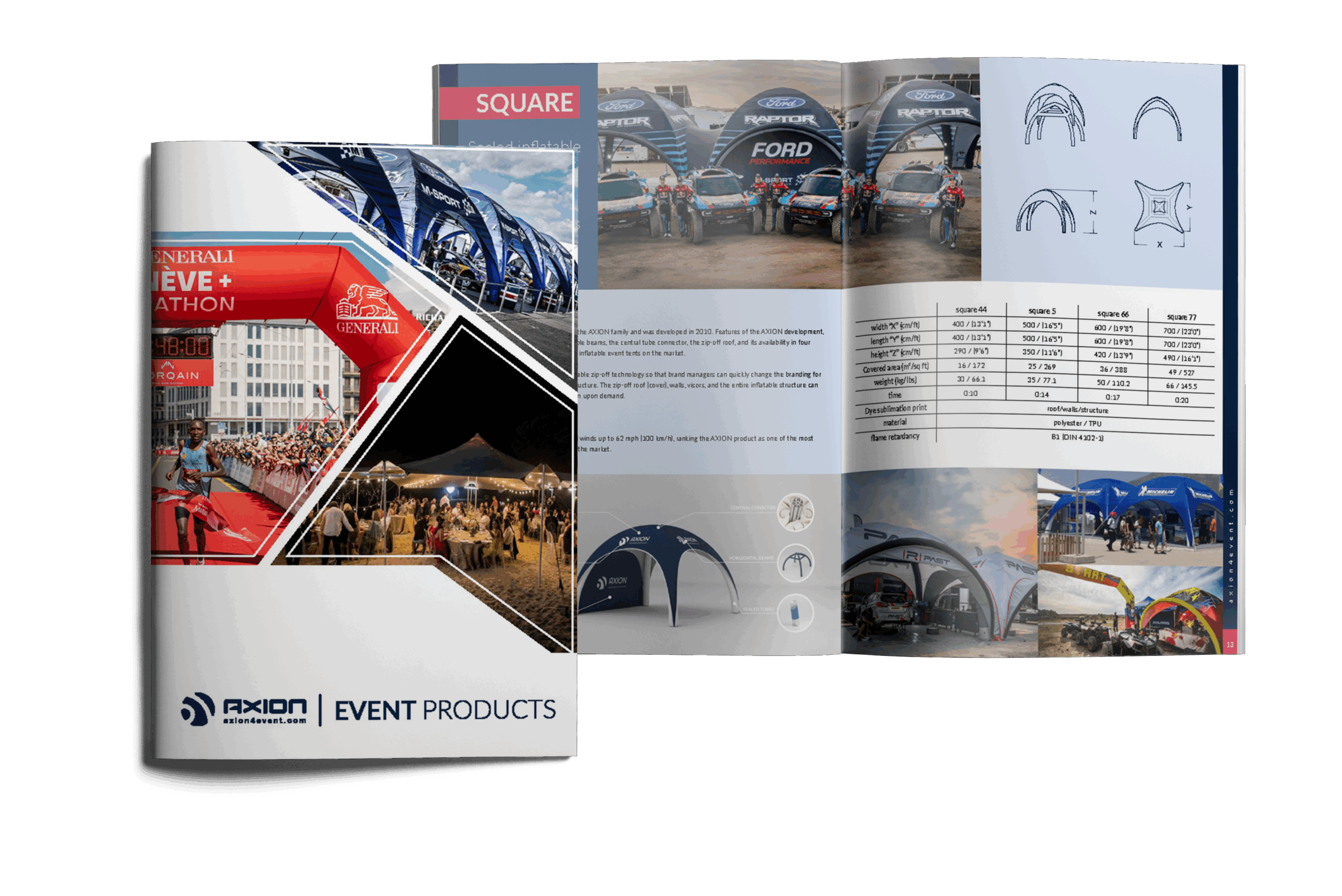
Explore the AXION range of sealed inflatable event tents, including the SQUARE, CUBE, HEXA, SPIDER and POD.
Customers in the United States can contact ZEPELIN USA directly at sales@axion4event.com or +1 (239) 428 1027.