
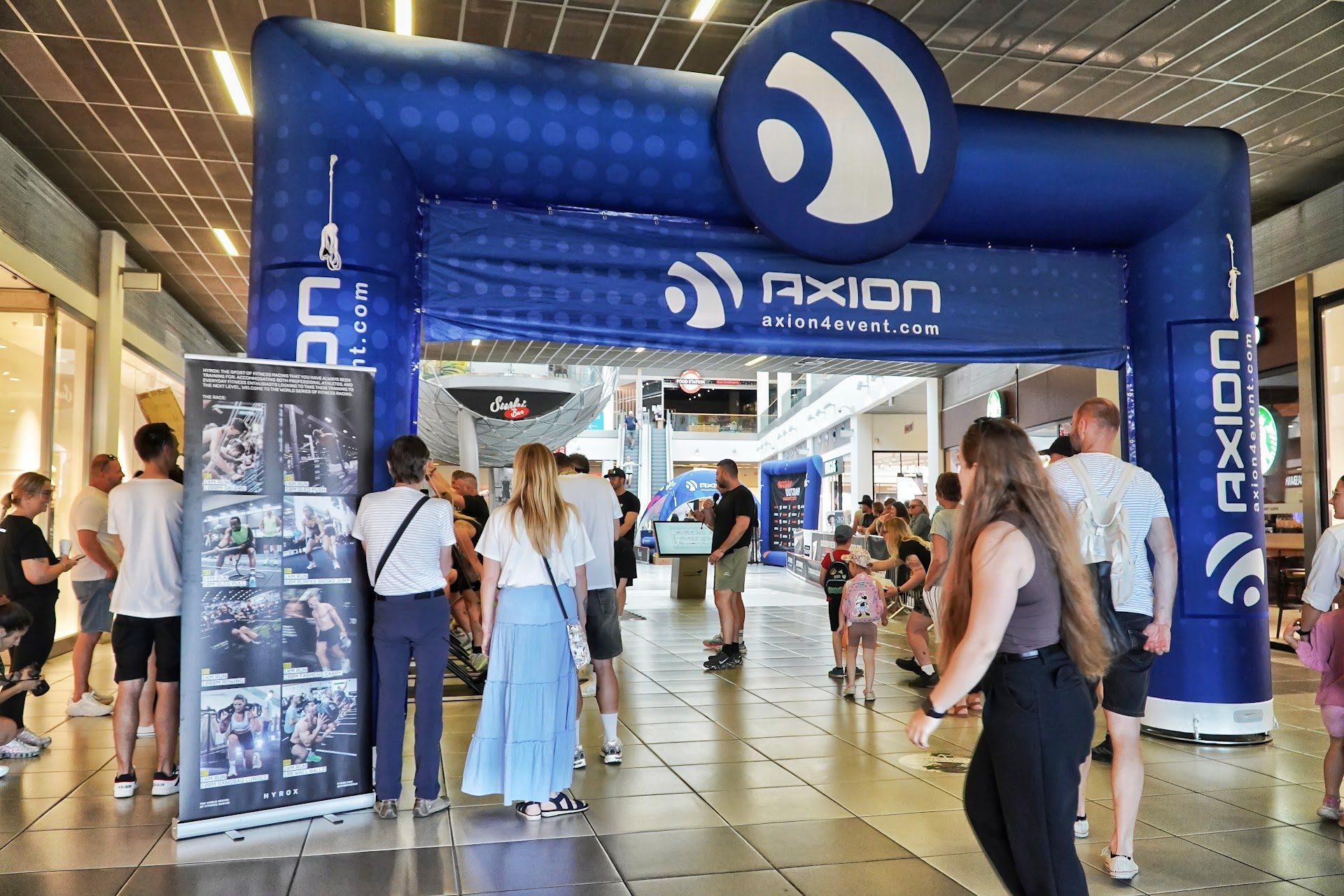
At an outdoor event, you think about wind, rain, ground conditions and anchoring.
Move the same activation inside an exhibition hall and wind disappears from the equation.
The rules do not.
Indoor events introduce a different set of questions. Does the structure comply with the maximum stand height? Does it interfere with access or evacuation routes? What documentation does the venue require? Which fire requirements apply to the materials? And where can the electrical equipment required for inflation be used?
Inflatable event structures can be used at indoor events when the specific product, installation and materials comply with the requirements of the organizer, venue and applicable local rules.
Simply fitting inside the booked floor area is not enough.
Are Inflatable Structures Suitable for Indoor Events?
Pneumatic technology itself does not automatically prevent a structure from being used indoors.
The specific installation needs to be assessed.
Relevant factors can include:
- structure dimensions and height,
- allocated exhibition footprint,
- entrances and exits,
- access and evacuation routes,
- venue fire requirements,
- materials,
- electrical equipment,
- inflation method,
- organizer rules.
What is accepted at one venue should not automatically be assumed to be accepted at another.
1. Start With the Venue’s Technical Requirements
Before designing the stand, request the organizer’s or venue’s technical manual.
It may define:
- maximum stand height,
- boundaries of the rented area,
- required clearances,
- aisle requirements,
- rules for covered or enclosed spaces,
- electrical connections,
- fire requirements,
- material documentation,
- installation schedules and conditions.
For a custom inflatable structure, knowing these restrictions before selecting the product can save considerable redesign later.
Venue first. 3D mockup second.
2. Check Height, Not Just Floor Area
Trade-show planning often begins with a booked footprint such as 6 × 6 metres (about 20 × 20 ft).
That only covers two dimensions.
An inflatable structure also has height, and exhibition venues may regulate it.
Before selecting a model, check:
- maximum permitted stand height,
- available hall clearance,
- technical elements above the stand,
- restrictions relating to neighbouring exhibits.
The structure needs to fit within the complete available space, not simply inside a square on the floor plan.
3. Plan Entrances, Exits and Visitor Flow
Trade-show visitors do not experience an exhibition stand from above.
They approach from an aisle, enter, stop at a product and move on.
Consider:
- entrance orientation,
- opening widths,
- counter and product placement,
- visitor circulation,
- organizer rules for aisles and evacuation routes.
Branding should also reflect the actual location of the stand. A prominent logo has limited value if it faces a wall or neighbouring exhibit.
4. What Fire-Safety Requirements Apply to Inflatable Event Tents?
There is no single global answer. Requirements can depend on:
- country,
- venue,
- event type,
- materials,
- structure size and configuration,
- intended use.
An organizer or exhibition venue may require documentation demonstrating specified fire properties of the materials used. AXION inflatable tent materials are certified to flammability class B1 under DIN 4102-1.
5. What Does the Construction Tell Us About Fire Performance?
AXION structures use TPU pneumatic chambers joined using high-frequency welding and an outer layer made from 500D high-tenacity polyester.
Those facts alone, however, do not establish a specific fire classification.
Material composition and certified fire performance are separate pieces of information.
It should therefore not be assumed that a particular material automatically complies with the requirements of every exhibition venue.
6. Why a Sealed Pneumatic System Can Be Practical Indoors
The way an inflatable structure maintains pressure is also relevant inside an exhibition hall.
AXION distinguishes between two systems.
A constant-air system requires a blower to supply air continuously.
A sealed pneumatic system is inflated and sealed, remaining pressurised without a continuous electrical connection.
For an indoor event, this can mean:
- less permanently operating electrical equipment,
- no continuously running blower,
- fewer cables associated with permanent blower operation,
- greater flexibility after inflation.
Electrical equipment used for inflation and any other equipment inside the stand must still comply with venue requirements.
7. Does an Inflatable Tent Need to Be Anchored Indoors?
Indoor conditions remove wind from the equation, but the method used to secure a structure still depends on the specific product and venue requirements.
There is no single rule for securing every model indoors.
It would therefore be incorrect to claim that an indoor inflatable structure never needs securing.
Check:
- requirements for the specific model,
- venue rules,
- permitted securing methods.
Exhibition halls may also prohibit certain forms of floor fixing, so this should be resolved before installation.
8. Enclosed Structures May Introduce Additional Requirements
An open inflatable structure and a fully enclosed event space may not be treated identically by a venue.
Adding side walls or creating an enclosed room may introduce additional requirements relating to:
- entrances and exits,
- evacuation routes,
- occupancy,
- fire safety,
- visibility of safety features.
Exact requirements must come from the venue or relevant authority.
This is why a quotation brief should describe the planned configuration, not simply the tent dimensions.
9. Build the 3D Mockup Around the Real Exhibition Space
A 3D design becomes considerably more useful when it reflects the actual venue.
If you know:
- stand dimensions,
- aisle locations,
- main visitor flow,
- neighbouring stands,
- height restrictions,
the orientation and branding can be designed around the environment where the structure will actually appear.
This helps prevent your largest logo from spending three days enthusiastically advertising itself to the back wall.
Indoor vs. Outdoor: What Changes?
| Factor | Indoor Event | Outdoor Event |
|---|---|---|
| Wind | Usually not a primary factor | Major consideration |
| Rain/snow | Usually irrelevant | Must be considered |
| Surface | Venue flooring | Grass, gravel, asphalt, concrete etc. |
| Height limits | Often defined by venue | Depends on site/event |
| Fire requirements | Particularly relevant | Depends on event/location |
| Evacuation routes | Defined within venue/event rules | Depends on event layout |
| Electricity | Subject to venue rules | Depends on site |
| Securing/anchoring | Product + venue dependent | Product, surface + weather dependent |
This comparison does not replace the technical requirements of a specific event. It illustrates why an indoor installation should not simply be treated as “outdoor without wind.”
What Should You Request From the Organizer?
Before finalising the structure, obtain:
- exhibitor technical manual,
- exact stand floor plan,
- maximum permitted height,
- temporary-structure requirements,
- fire requirements for materials,
- required certificates and documents,
- electrical rules,
- securing requirements,
- installation and dismantling schedule.
These can then form part of the brief supplied to the structure provider.
Common Indoor Event Mistakes
1. Checking the Footprint but Not the Height
The tent fits inside 6 × 6 metres (about 20 × 20 ft). Excellent. Unfortunately, the venue also has a height limit.
2. Leaving Fire Documentation Until the Last Minute
If the venue requires it, establish that before selecting the final solution.
3. Assuming Indoor Means Rule-Free
No wind does not mean no requirements.
4. Designing Branding Without the Hall Layout
Your strongest branding may end up facing a wall rather than visitor traffic.
5. Forgetting About Side-Wall Configuration
A more enclosed structure can affect visitor circulation and venue requirements.
Frequently Asked Questions
Are inflatable event structures safe to use at indoor trade shows?
They can be used indoors when the specific product, materials and installation comply with organizer, venue and applicable local requirements.
Does an inflatable tent require special permission inside an exhibition hall?
This depends on the venue, jurisdiction, event and structure. Requirements should be confirmed with the organizer before installation.
What fire safety certifications should an inflatable event tent have?
There is no single global certification that applies to every event. The required classification or documentation is determined by the venue and applicable rules. AXION inflatable tent materials are certified to flammability class B1 under DIN 4102-1; ask AXION for the documentation your venue requires.
Does a sealed pneumatic tent need a blower running throughout the trade show?
No. An AXION sealed pneumatic system remains pressurised after inflation without requiring a continuously operating blower.
Does an inflatable tent need anchoring indoors?
The securing method depends on the specific product and venue requirements. It should not be assumed that every indoor inflatable structure can simply be installed without securing.
What should I ask the exhibition venue first?
Confirm the allocated footprint, maximum height, temporary-structure rules, fire requirements, required documentation and installation conditions.
Should I know the stand location before finalising the branding?
Yes. Aisle position and visitor flow can determine which sides of the structure should carry the most important branding.
Indoor Event Checklist
- ✓ Exhibition footprint
- ✓ Maximum permitted height
- ✓ Venue technical manual
- ✓ Temporary-structure requirements
- ✓ Required fire documentation
- ✓ Material certificates requested by the venue
- ✓ Entrances and exits
- ✓ Access and evacuation routes
- ✓ Side-wall configuration
- ✓ Structure securing method
- ✓ Electrical requirements
- ✓ Stand position and visitor flow
- ✓ Installation and dismantling conditions
Conclusion
Moving an event indoors removes wind and rain.
It does not remove technical requirements.
Before designing an inflatable trade-show structure, confirm the available footprint, height restrictions, fire requirements, required documentation and the rules of the specific venue.
A sealed pneumatic system can also be practical indoors because it does not require a blower to operate continuously after inflation.
Instead of asking only:
“Will the tent fit?”
ask:
“How should the structure be designed to work within the space and requirements of this specific event?”
Planning an Inflatable Trade-Show Space?
Send AXION your exhibition dimensions, organizer requirements and branding. A suitable structure can then be selected and visualised for the specific event.
Explore the AXION range of sealed inflatable event tents, including the SQUARE, CUBE, HEXA, SPIDER and POD.
Customers in the United States can contact ZEPELIN USA directly at sales@axion4event.com or +1 (239) 428 1027.


