
At first glance, they do the same job.
Both create a covered space for a brand, products, staff or visitors.
Technically, however, they work very differently.
A traditional frame tent maintains its shape through a rigid supporting frame. A sealed pneumatic inflatable tent uses pressurised air chambers to create its supporting structure without requiring a continuously operating blower.
This difference affects setup, transportation, operation and visual possibilities.
So which system makes more sense?
That depends on the event and how the structure will be used.
Inflatable vs. Frame Tent at a Glance
| Factor | Sealed Pneumatic Tent | Traditional Frame Tent |
|---|---|---|
| Supporting structure | Pressurised air chambers | Rigid frame |
| Setup | Inflation | Manual frame assembly |
| Continuous blower | No | Not applicable |
| Power to maintain structure | Not required | Not required for frame |
| Rigid structural components | Fewer | Multiple frame components |
| Branding | Large textile areas + custom shapes | Depends on cladding system |
| Anchoring | Required according to product/site | Required according to product/site |
| Outdoor use | Model-specific limits | Model-specific limits |
| Repeated events | Suitable | Suitable |
The fundamental difference is therefore how the supporting structure is created.
How Does a Sealed Pneumatic Tent Work?
A sealed pneumatic structure is inflated to the required pressure and then sealed.
It does not require continuous electrical power to maintain pressure after inflation.
This distinguishes it from constant-air inflatable structures, where a blower operates continuously.
With a sealed system:
inflate → close the valves → the structure remains pressurised.
Power may still be required for lighting, screens or other event equipment, but not simply to keep the structure inflated.
How Does a Traditional Frame Tent Work?
A traditional event tent uses rigid components to form its supporting structure, with roofing and optional side walls attached to the frame.
Exact designs vary between manufacturers.
Setup typically involves:
- frame components,
- connectors,
- textile covering,
- anchoring,
- accessories.
For recurring events, it is therefore useful to consider not only setup time but also how many components need to be transported, unloaded, assembled, checked and packed again.
1. Setup: The Main Difference Is the Technology
A sealed pneumatic structure does not require assembly of a conventional rigid supporting frame.
Its supporting structure is created by inflating pneumatic chambers.
A traditional solution requires physical assembly of its frame components.
This distinction can become particularly relevant for:
- roadshows,
- touring events,
- sports-event series,
- festival seasons,
- recurring brand activations.
A repeated task that seems minor at one event becomes considerably more important across twenty stops.
2. Transportation: Do Not Compare Weight Alone
Transportation is about more than kilograms.
Consider:
- number of separate components,
- packed dimensions,
- number of transport cases,
- loading requirements,
- required vehicle.
A sealed pneumatic structure eliminates a conventional rigid supporting frame.
That does not automatically mean every inflatable model is lighter or smaller than every frame tent.
Compare equivalent products designed for similar usable areas and applications.
3. Power: Sealed Pneumatic Does Not Need a Continuous Blower
This is an important distinction between inflatable technologies.
AXION differentiates:
Constant-air: the blower supplies air continuously.
Sealed pneumatic: the structure is pressurised and sealed, so continuous electrical power is not required to maintain pressure.
When comparing an AXION sealed structure with a traditional frame tent, neither requires continuous electricity simply to remain standing.
4. Branding: The Structure Can Become Part of the Brand
Event infrastructure is not merely shelter.
It can be one of the largest visual assets at an activation.
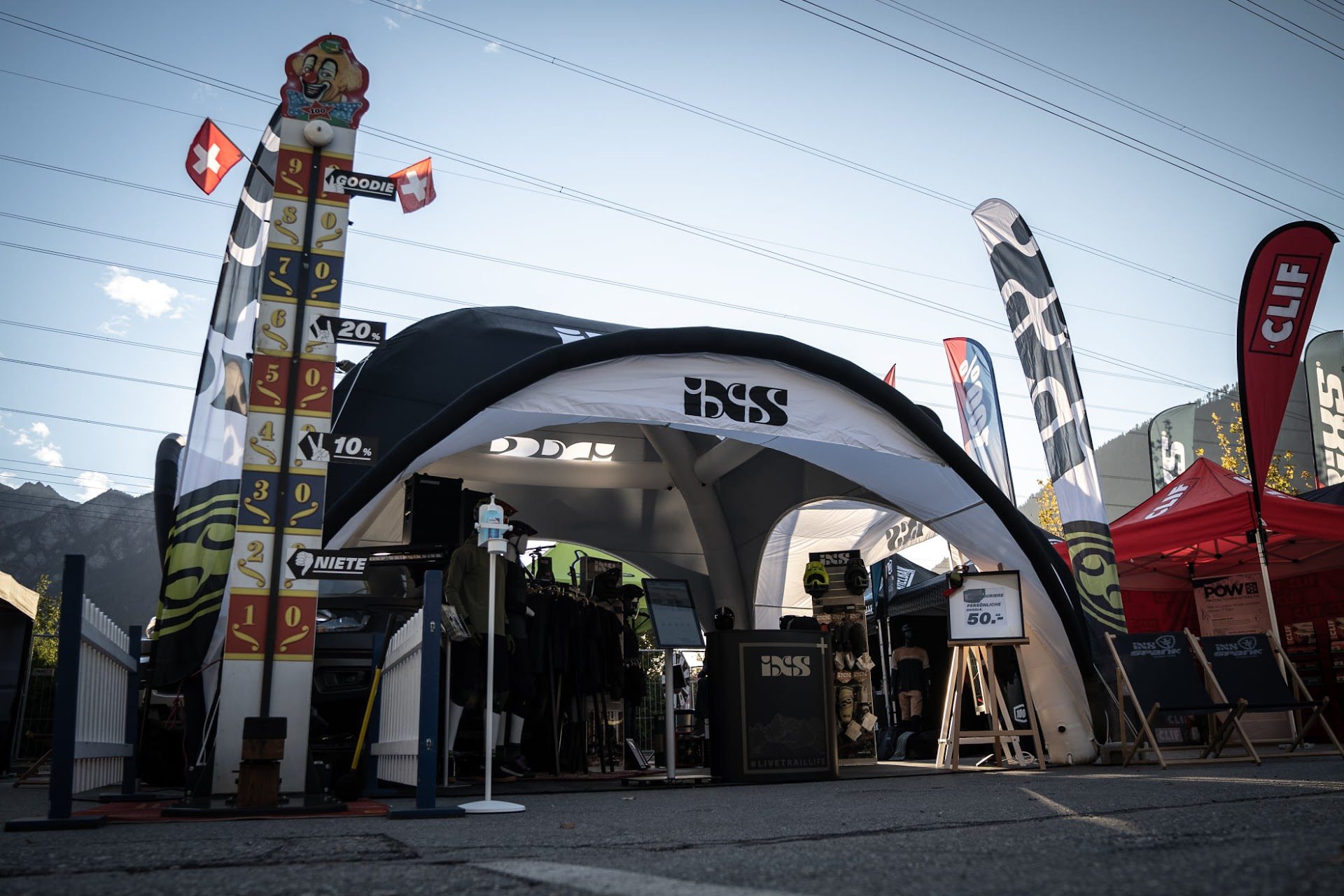
Inflatable structures allow branding across large textile areas and can also use the volume and shape of the structure itself as part of the visual concept.
Branding can include:
- roofs,
- supporting elements,
- side walls,
- entrances,
- additional textile surfaces.
Traditional frame tents can also be branded, with possibilities depending on the specific frame and cladding system.
The question is therefore not only:
“How much covered space do we need?”
It can also be:
“What role should the structure itself play in our event identity?”
5. Wind: Both Systems Need Appropriate Securing
Inflatable does not mean “blows away in a breeze.”
Rigid frame does not mean “immune to wind.”
Both outdoor systems need to be used within their model-specific technical limits and secured appropriately.
AXION states certified wind resistance up to 60 km/h (37 mph) when properly anchored (tested up to 100 km/h / 62 mph), with the exact figure depending on the model and potentially being higher for larger structures.
Traditional frame tents should likewise be assessed using their manufacturer’s specifications.
Without comparing two specific models, it would therefore be misleading to claim that either technology is universally more wind resistant.
6. Both Systems Require Anchoring
Outdoor structures need appropriate securing regardless of technology.
AXION uses different approaches according to the surface, including:
- steel stakes and guy ropes for grass,
- heavy-duty stakes for gravel or rocky surfaces,
- ballast bags, weights or mobile anchoring points for concrete and asphalt,
- snow anchors or weights for snow and ice.
Inflatable technology does not eliminate the need for appropriate anchoring.
7. What Happens if the Structure Is Damaged?
AXION sealed pneumatic structures use multiple independent air chambers.
If one chamber is damaged, the others can remain pressurised and the entire structure does not necessarily collapse immediately.
A traditional frame structure has a different failure profile because rigid components provide its structural support.
It would therefore be misleading to describe either technology as universally safer.
They use different structural principles and have different potential failure modes.
8. Which System Is More Practical for a Roadshow?
This is where repeated use becomes particularly important.
A roadshow does not involve setting up once.
It involves doing it again. And again. And again.
Compare:
- setup time,
- crew requirements,
- packed volume,
- number of components,
- storage requirements,
- serviceability,
- branding updates.
A sealed pneumatic system can be particularly relevant where repeated handling and strong branded visibility are priorities.
The actual advantage should still be evaluated using specific models and the planned event scenario.
When Can a Sealed Pneumatic Tent Make Sense?
Particularly when:
- you attend multiple events each year,
- locations change frequently,
- strong branded visibility is important,
- you want fewer rigid structural components,
- you operate a roadshow or touring concept,
- custom visual design matters,
- you do not want a continuously operating blower.
When Can a Traditional Frame Tent Make Sense?
For example, when:
- you already own a compatible frame system,
- your logistics and crew are built around it,
- you need a straightforward standard configuration,
- a particular frame model fits the event requirements better,
- custom pneumatic shapes are unnecessary.
The decision should be based on the job the structure needs to perform rather than the technology label.
How Should You Compare Two Specific Event Tents?
Use the same brief for both systems.
Compare:
1. Usable Space
How much functional area does each solution provide?
2. Setup
How many people and how much time are required?
3. Transportation
What are the packed dimensions and logistics requirements?
4. Operation
What equipment is required during the event?
5. Outdoor Limits
What are the specifications of each particular model?
6. Branding
Which surfaces can be branded and how?
7. Service
How are damaged components repaired or replaced?
8. Total Cost
Consider purchase price, transportation, setup, storage, servicing and expected number of deployments.
This creates a much more useful comparison than simply asking which technology is “better.”
Frequently Asked Questions
What is the main difference between an inflatable and a frame event tent?
A traditional frame tent uses a rigid supporting structure. A sealed pneumatic tent creates its supporting structure using pressurised air chambers.
Does an inflatable tent need electricity throughout an event?
An AXION sealed pneumatic system does not require continuous electrical power to maintain pressure after inflation.
Is an inflatable tent more wind resistant than a frame tent?
That cannot be stated universally without comparing specific models. Both technologies have model-specific technical limits and require appropriate securing.
Is an inflatable tent suitable for roadshows?
It can be particularly practical for recurring events where repeated handling, transportation and branded visibility are important. Specific model parameters should determine the final choice.
Does an inflatable tent need anchoring?
Yes. Outdoor inflatable structures must be secured appropriately for the model, surface and conditions.
What happens if an air chamber is damaged?
In AXION sealed pneumatic structures using independent chambers, unaffected chambers can remain operational, so damage to one does not necessarily result in immediate collapse.
Which type of event tent is cheaper?
There is no universal answer without comparing specific products. Purchase price should be considered alongside transport, setup, storage, servicing and expected number of uses.
Decision Checklist
- ✓ Events per year
- ✓ Event types
- ✓ Number of locations
- ✓ Required usable space
- ✓ Available setup crew
- ✓ Setup time
- ✓ Transportation capacity
- ✓ Outdoor conditions
- ✓ Required branding area
- ✓ Custom-design requirements
- ✓ Servicing and repair
- ✓ Storage
- ✓ Total cost over planned use
Conclusion
Inflatable and traditional frame tents can fulfil the same basic purpose at an outdoor event.
They simply reach that result through different technologies.
A frame tent relies on rigid supporting components. A sealed pneumatic system creates its supporting structure using pressurised chambers and does not require a continuously operating blower after inflation.
Rather than searching for a universal winner, compare specific solutions according to setup, transportation, outdoor specifications, branding, servicing and frequency of use.
For recurring roadshows in particular, the important question is not only how the system performs at the first event.
It is how efficiently it continues to work at the tenth, twentieth and fiftieth deployment.
Comparing Event Infrastructure Options?
Send AXION your event types, required dimensions, expected number of deployments and branding requirements to identify a solution suited to your actual event programme.
Explore the AXION range of sealed inflatable event tents, including the SQUARE, CUBE, HEXA, SPIDER and POD.
Customers in the United States can contact ZEPELIN USA directly at sales@axion4event.com or +1 (239) 428 1027.


