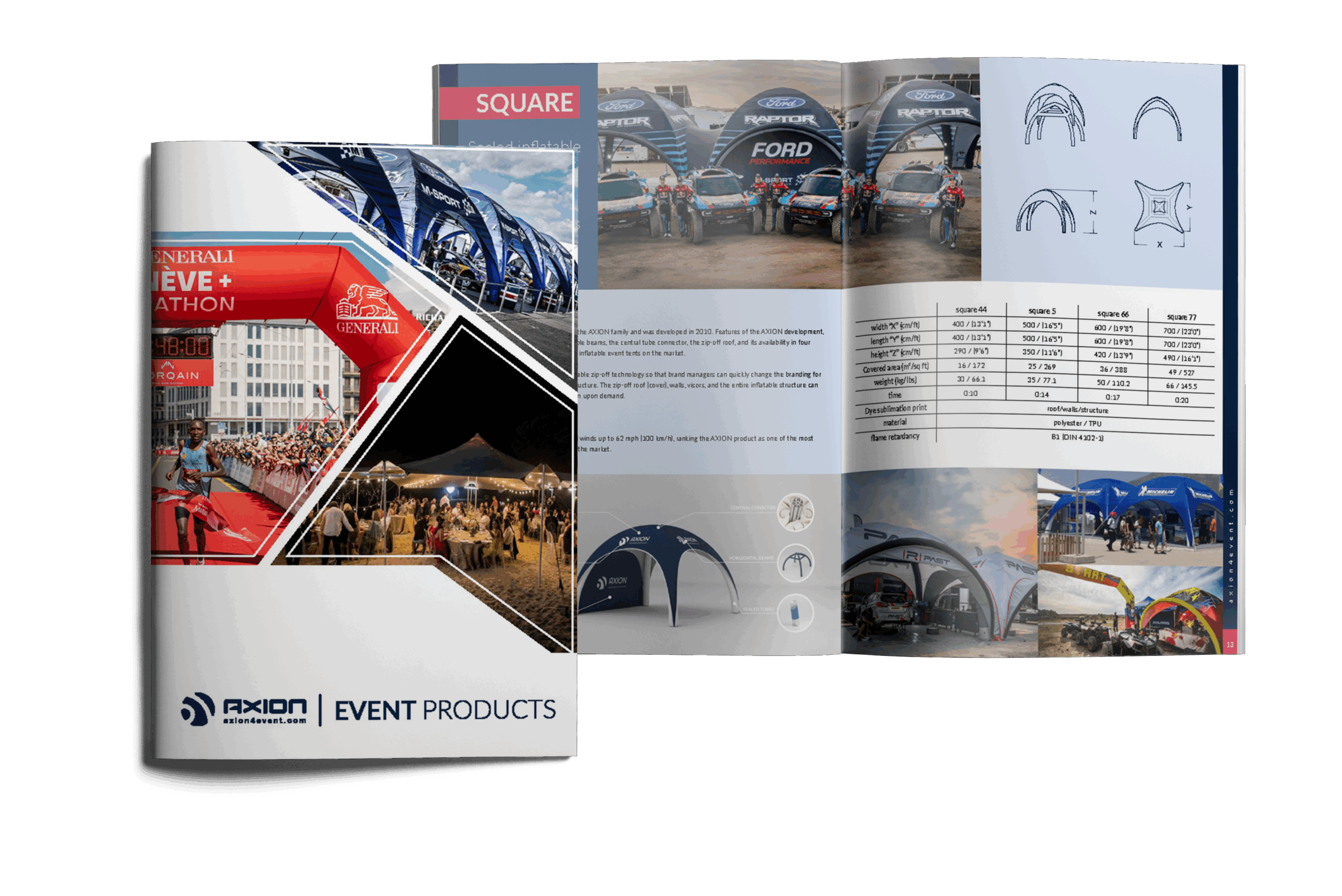
It can all begin with one simple sentence:
“We need a branded tent for our roadshow.”
But between that sentence and a finished structure standing at the first event, several important decisions need to be made.
How much space do you need? Where will the structure be used? Will it travel between multiple locations or remain installed for several days? Do you need an open promotional area, an enclosed space, or a more complex configuration? And where should the logo, campaign visuals and key message appear?
Custom event infrastructure therefore does not begin with production.
It begins with a good brief.
The clearer the requirements are at the beginning, the easier it becomes to select the right structure, prepare the branding and avoid unnecessary changes later in the process.
1. Start by Defining What the Tent Needs to Do
Size is only one part of the specification.
A structure of the same dimensions can perform very differently at a trade show, festival, motorsport event or travelling roadshow.
Before selecting a model, clarify:
- What types of events will it be used for?
- Will those events primarily be indoors or outdoors?
- How many people need to use the space?
- What equipment or products will be placed inside?
- How frequently will the structure travel?
- What surfaces will it typically be installed on?
- Do you need side walls or an open layout?
- What role should branding play?
The intended use helps determine whether you need a compact promotional structure or a larger event space.
2. Select the Appropriate Structure and Size
Once the purpose is clear, the next step is selecting a suitable solution.
The footprint matters, but so do practical requirements.
Size and Usable Space
The structure needs to provide enough room for the intended activity, but bigger is not automatically better.
For a travelling roadshow, for example, the space must be visually impressive while remaining practical to transport and repeatedly deploy.
Intended Use
An open promotional point has different requirements from a VIP area or a product presentation where equipment needs additional protection.
Transport and Repeated Setup
If the structure will attend multiple events during a season, packed dimensions and handling become just as relevant as its appearance.
3. Branding Should Be Considered Before Production
Branding should not be treated as a sticker added to a finished tent at the last minute.
For a professional result, the visual concept should be developed around the actual structure.
Important considerations include:
- logo position,
- scale of key brand elements,
- visibility from different directions,
- corporate colours,
- campaign messages,
- branding visibility with different wall configurations.
Artwork that looks balanced on a computer screen may behave very differently when applied to a structure several metres wide.
4. What Information Is Needed for a Custom Branded Inflatable Tent?
Exact requirements depend on the individual project, but useful materials can include:
- your logo in a suitable graphic format,
- brand guidelines, if available,
- corporate colours,
- campaign artwork,
- required text or campaign messages,
- information about how the structure will be used,
- details of the planned events.
If you do not yet know exactly which model you need, you do not necessarily need to begin with a technical drawing.
It is more useful to explain what the finished structure needs to achieve.
5. Review the Structure in 3D Before Ordering
With a large branded object, the finished product should not be the first time you see how the design works in three dimensions.
That is where a 3D mockup becomes valuable.
AXION’s process includes applying the customer’s branding to the selected product before an order is placed.
The visualisation can help you assess:
- whether the logo is prominent enough,
- how artwork works across individual sides,
- whether text remains readable,
- how colours interact,
- whether key visual elements are visible from relevant viewing angles.
Why Is a 3D Mockup More Useful Than a Flat 2D Design?
Because an event tent is not a flat banner.
Visitors see it from the front, sides, a distance and close up. Some visual elements can also change significantly depending on the viewing angle.
A 3D mockup allows branding to be evaluated in the space where it will actually work.
6. Review, Feedback and Final Approval
The first design does not have to be the final one.
The visualisation stage provides an opportunity to adjust elements before the project moves forward.
Changes might include:
- increasing logo size,
- repositioning a campaign message,
- simplifying artwork,
- adjusting colours,
- changing the distribution of branded elements.
Moving a logo in a 3D design is considerably easier than discovering the issue after production.
7. What Happens After the Design Is Approved?
Once the solution and artwork are approved, the project can move towards ordering and production.
Professional inflatable structures involve more than a printed outer shell.
AXION uses sealed pneumatic systems with enclosed air chambers that remain pressurised after inflation without requiring continuous electrical power.
AXION structures use seamless TPU pneumatic chambers joined using high-frequency welding and enclosed within 500D high-tenacity polyester.
The finished structure therefore combines its visual branding layer with a functional pneumatic system.
How Long Does It Take to Produce a Custom Inflatable Structure?
Production time depends on the selected product, the level of customisation and current production conditions.
The most reliable approach is to ask AXION for the current lead time for your specific project as early as possible, ideally together with the date of your first planned event.
What Can Slow Down the Process Before Production?
Whatever the manufacturing lead time, preparation will generally be easier when the required inputs are complete.
Potential delays can occur when:
- final artwork is not ready,
- the brief changes during the design stage,
- intended use has not been clearly defined,
- branding requires several approval rounds,
- the concept changes substantially after the 3D mockup.
For event infrastructure, it is therefore useful to plan backwards from the first event date and allow time for design preparation, review and approval as well as production.
What Should a Custom Inflatable Tent Brief Include?
You do not need to arrive with a complete technical specification.
Start with the questions that define how the structure will actually be used.
| Question | Why It Matters |
|---|---|
| What events will the tent be used for? | Helps identify a suitable solution |
| Indoor or outdoor? | Influences usage requirements |
| How much space is required? | Helps determine size |
| How frequently will it travel? | Important for logistics |
| What branding is required? | Defines the visual preparation |
| When is the first event? | Essential for project planning |
| What accessories are needed? | Helps create a complete setup |
A clearer brief means fewer unknowns later in the project.
6 Common Mistakes When Ordering a Custom Event Tent
1. Choosing Based on Size Alone
Dimensions without context do not tell you whether the structure will suit the actual activation.
2. Leaving Branding Until the End
Graphics should be part of the design process, not an afterthought.
3. Forgetting About Transport
For roadshows in particular, think about the full cycle: pack, transport, install, use, pack again and move to the next location.
4. Failing to Explain How the Structure Will Actually Be Used
“We need a 6 × 6 m tent” is information.
“We need a roadshow space that will travel frequently and be repeatedly installed by our event team” is a much more useful brief.
5. Reviewing the 3D Mockup Only for Aesthetics
Check readability, logo visibility and how individual elements work from different angles.
6. Starting the Project Too Late
The timeline does not consist of production alone. Product selection, artwork preparation, visualisation, feedback and final approval also require time.
Frequently Asked Questions
How is a custom inflatable tent made?
The process begins by defining the intended use and selecting a suitable structure. Branding is then prepared and reviewed through a 3D mockup. After feedback and approval, the project can proceed to ordering and production.
What do I need to order a custom inflatable event tent?
Useful information includes the type of events, approximate space required, intended use, first event date and branding requirements. Logos, brand guidelines and campaign artwork should also be supplied where available.
Can I see a 3D mockup before production?
Yes. AXION’s process allows branding to be applied to the selected product before the order is placed, giving you an opportunity to review the proposed appearance.
Can the branding be changed after reviewing the 3D mockup?
Yes. The visualisation stage is intended to allow feedback and design adjustments before ordering.
How long does custom inflatable tent production take?
It depends on the selected product, level of customisation and current production conditions. Ask AXION for the current lead time for your project and share the date of your first event early.
Does a sealed pneumatic tent need a blower running throughout the event?
No. AXION sealed pneumatic chambers remain pressurised after inflation without requiring a continuous electrical connection.
Do I need to know exactly which model I want?
Not necessarily. A clear description of how the structure will be used, how much space is required and what the event environment looks like provides a useful starting point.
Pre-Brief Checklist
- ✓ We know what types of events the structure will attend.
- ✓ We know the approximate space required.
- ✓ We know the date of the first planned event.
- ✓ Our logo and brand assets are ready.
- ✓ We know whether walls or additional accessories are required.
- ✓ We understand how frequently the structure will travel.
- ✓ We know what will happen inside the tent.
- ✓ Someone is responsible for approving the 3D visualisation.
Conclusion
A custom inflatable tent does not begin on the production floor.
The most important decisions happen before manufacturing starts.
Purpose, dimensions, logistics, branding and intended use determine whether the structure will work not only in a visualisation, but at the tenth or twentieth event as well.
A strong process therefore begins with “What does this structure need to do?”, continues through the 3D design stage and moves towards the finished product only once the important details have been agreed.
See Your Event Tent Before It Goes Into Production
Send AXION your brief and branding materials. The design team can prepare a 3D visualisation showing how your inflatable event structure could look with your branding applied.
Get a 3D Visualisation